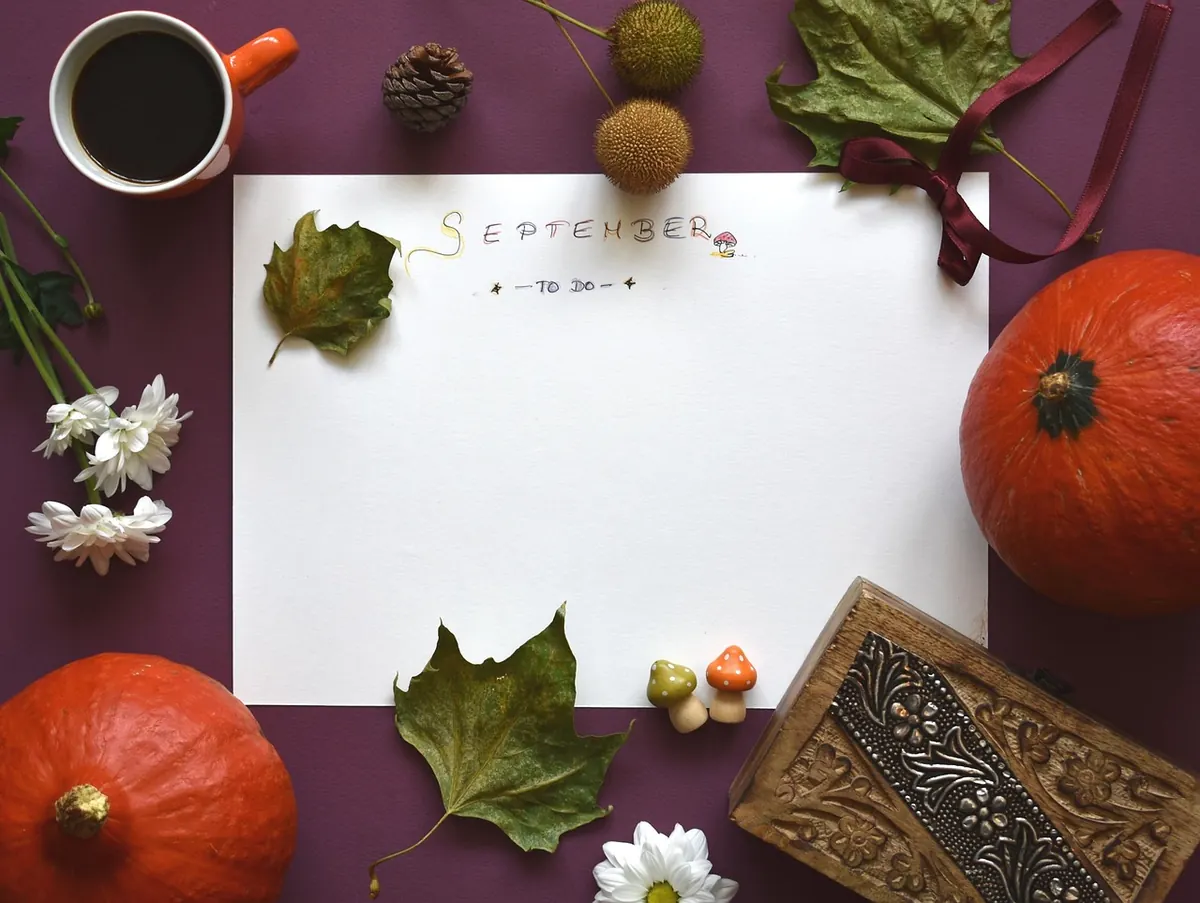
Autumn arrives with an inventory. The light goes amber earlier than you expect. A neighbour's woodsmoke shows up on a Tuesday evening and then disappears for a week. The corner shop puts the paper lanterns out and takes them down again. None of it is dramatic, which is exactly why it works as writing material: the season hands you a steady supply of specific, concrete detail and asks only that you notice it.
What follows is a set of prompts and observation exercises built around those details. None require much time or a particular mood. Most take ten minutes and a page. The aim is not to write about autumn in general, but to gather the small facts of this autumn, and then let those facts push a poem, a scene, or a character into motion.
Walk the Same Route Three Times
Most of us notice a season once and then stop. A better method is repetition with attention. Choose one walk you already take — to the bus stop, around the block, through the cemetery shortcut — and walk it three times in ten days, at roughly the same hour. Write down only what has changed.
The changes are usually unglamorous and useful. A drain that was dry is running. The bench by the church has a coat of green on it. Someone has pruned the hedge to knee height and the pavement is scattered with cut stems. By the third pass you notice what a first glance never gives you: that the yellowing starts at the top of the lime trees and moves down, or that the same dog is walked by the same person but twenty minutes later.
Keep the notes ugly. Bench damp. Vinegar smell near the bins. Two magpies on the wire, gone by Thursday. Ugliness is fine at this stage. You are collecting, not composing.
Build a Sensory Inventory
Autumn is easy to describe badly because it is easy to describe generically. Guard against that with an inventory that gives each sense its own column. Fill it over a week rather than in one sitting.
- Sight: Not "golden leaves." The exact colour of one leaf against a wet kerb. A streetlamp seen through a bare branch as a shape rather than a glow.
- Sound: A leaf blower three streets away, more mosquito than machine. The crunch of a frozen puddle at eight in the morning that has turned to slush by noon.
- Smell: Wet wool. Dust burning off a radiator for the first time since spring. The inside of a coat that has been in a cupboard since March.
- Touch: The cold of a metal handrail coming through a glove. A scarf that is too warm by eleven o'clock.
- Taste: The metallic taste of cold air when you breathe through your mouth on a bicycle. Over-steeped tea forgotten on a desk.
Add a sixth column if you like: temperature as felt on one specific part of the body — ankles, ears, the backs of the hands. It is often the quickest way into a scene.
Prompts from Ordinary Routine
Daily habits shift in autumn, and every shift is a prompt. Take one and give it a hard limit: 150 words, no adjectives of colour. Constraint makes the detail work harder.
- Write a paragraph about the first morning you need the heating on. Who notices first in the household, and what do they do about it?
- Someone is putting away summer clothes. Give them one item they cannot bring themselves to store.
- Write a scene set entirely in the ten minutes when the light fails, before anyone switches a lamp on.
- Describe a room from the point of view of a radiator coming on for the first time since spring.
- A character now commutes in darkness both ways. What do they start doing with that time?
- Write about a person who forgets to change the clocks, or refuses to, or does it a week early.
The Trouble with "Pretty"
The risk with seasonal writing is the postcard: a description that is accurate about autumn in general and wrong about nothing in particular. A quick test — cross out every adjective in a paragraph and see what survives. If the sentences lose nothing, the adjectives were doing no work.
Replace mood with an object. Instead of "the melancholy evening," write the two chairs on the balcony with rain in the seat of one. Instead of "the crisp, golden season," write the man on the number 12 bus wearing gloves but no coat, and the woman opposite in a coat but no gloves. Contradictions are almost always more convincing than atmosphere.
Write the Unpleasant Version
Also write the autumn nobody puts on a card: the wet-dog smell in a hallway, the takeaway containers stacked by the bin because nobody wants to go out again, the draught that finds a flat with single glazing. Not grim for its own sake, but because a reader recognises it, and recognition is what keeps them reading.
Attach the Detail to Someone
Observation becomes fiction when you hand your notes to a person. Take three details from your inventory — a wool scarf, a leaf blower at seven in the morning, a cup of tea gone cold — and give each to a character along with a reason they care about it.
A woman who hates the leaf blower because her husband used to clear the leaves before he died. A student who wears the scarf in October because his mother knitted it too long and he has never had it shortened. The reasons do not need to be tragic. A man who drinks the cold tea because he is trying to stop wasting things is already a character.
Then push once more: write the same small scene twice, once from the person who notices the detail and once from the person who causes it. The neighbour with the leaf blower has a schedule, a bad back, and no idea that anyone is listening.
Keeping the Season Working
Keep a single running page, dated, with the place noted at the top. Three lines a day is enough. Don't edit while you collect; editing early kills the odd detail before it has a chance to be useful. In December, read the whole page back and mark the three observations that still feel alive. Those are the ones to build from. The rest can stay where it is.
Treat prompts as a way in, not a subject. If a prompt produces nothing, steal the detail and abandon the prompt. And set yourself a finish line: by the end of November, take one page of notes and turn it into five hundred finished words. Not good words — finished words. A draft you can revise is worth more than a notebook of good intentions, and the season will come round again next year with new weather and a method already in place.
Photo: marijana1 / Pixabay