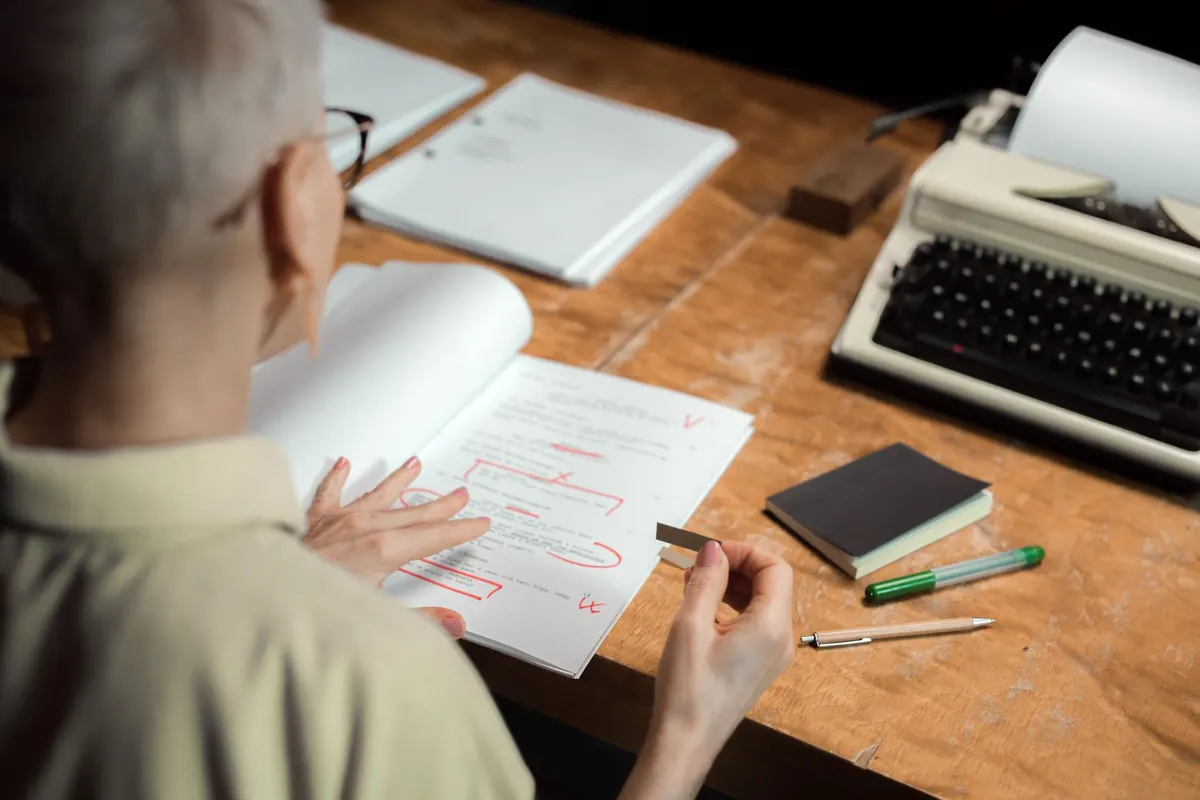
You finish a draft late at night, and the flaws are right there in front of you: a sentence in the third paragraph that says the same thing twice, a character who walks into a room and never leaves, a tense that slips somewhere around page four. Your hands want to fix the commas. Let them wait.
Polishing is the last job, not the first, because polish makes decisions look settled. Once a paragraph reads smoothly, you stop asking whether it belongs. The work that comes before that is unglamorous, cheap and fast. It takes an hour, maybe two, and it can save you from rewriting sentences you were going to cut anyway.
Here are the eight things worth settling before the first real revision pass.
Draft Zero Is a Version, Not a Verdict
A draft zero is the version you write to find out what you are making. It is allowed to be shapeless, repetitive and a third too long. What it is not allowed to be is undecided.
That is the trap. Most drafts feel nearly finished because the sentences are finished. The prose has rhythm, the dialogue sounds like people talking, the images are doing something. So you assume the piece is close, and you start sanding. Three hours later you have a beautifully polished opening that you delete in the next round, because the piece turned out to be about something else.
The notes an editor leaves on a draft are rarely about grammar. They are questions of intent: Why does this scene come before that one? Who is this paragraph for? What happens if you cut the first two pages? Answering those questions is not writing. It is choosing. Do the choosing first and the rewriting gets shorter.
The Eight Decisions
Before you touch a line, write short answers to these. Note form is fine. Half a page is generous.
- Purpose. What should this piece do for someone who reads it to the end?
- Audience. Who exactly is reading, and what do they already know?
- Promise. What does the opening imply you will deliver, and does the draft deliver it?
- Shape. What is the spine, described in one sentence?
- Throughline. What question or tension holds the middle together?
- Load-bearing parts. Which two or three passages must survive any cut?
- Surplus and gaps. What is doing no work, and what is missing but needed?
- First pass. Which single job do you do next, and by when?
Purpose and Audience in Plain Words
What the piece is for
Not the topic — the job. A personal essay about leaving a job is not for describing the job; it is for showing what the leaving cost and what it bought. A short story about a broken-down car is not for the car.
Try finishing this sentence without abstractions: This piece should make a reader who has never met me feel __________. If you cannot fill the blank, the draft is still exploring, and that is useful information. It means the next pass is discovery, not revision. Write two more pages before you polish anything.
Who is reading, and what do they already know
Pick one real person and write for them. If that person works in kitchens, you do not need to explain the pass, the wipe-down, the way a service ends. If they have never worked a shift, you need three sentences of grounding and no more.
Most drafts have an exposition problem that is really a decision problem. The draft explains too much in one place and too little in another because the audience was never fixed. Decide once and the problem mostly dissolves. The rule of thumb: give the reader what they need to follow the next paragraph, and trust them with the rest.
Shape: Where the Spine Is
Say it in one sentence
“It is one night in five scenes.” “It is seven jobs and what each one taught me.” “It is an argument in three moves, with the objection in the middle.” If you can say it, you have a draft. If you cannot, you have material — which is a fine thing to have, but it needs building before it needs polishing.
Find the load-bearing three
Highlight the passages you would fight to keep if the whole thing had to be rebuilt. Usually there are two or three. Name them. They tell you where the piece's real weight sits, and they are the parts everything else should be arranged around.
Then look at the ratio. If all three load-bearing passages are in the second half, your opening is setup you can compress hard. If they are all in the first half, the piece probably ends by explaining itself. That single check catches more structural problems than any outline.
What to Cut, What's Missing
Mark, do not fix. Two colours, two passes, no rewriting.
- The paragraph that explains what the reader just read.
- The second of two paragraphs doing the same job — keep the better one and note what the loser contained, in case you need it.
- The ending that repeats the opening in softer words.
- The character or anecdote you included because it happened, not because it earns its place.
- The scene you summarised because it was hard to write. Note it as a question: Can this be a scene instead?
- The thing you skipped. The reason someone stayed, the money, the part that would make a family member unhappy. Readers notice the missing weight even when they cannot name it.
Set Priorities for the First Revision Pass
One pass, one job. If you try to fix structure, pacing, voice and commas at once, you will make careful decisions about the wrong level. Work from the largest unit down: shape, then scenes or sections, then paragraphs, then sentences, then words.
Name the single most damaging problem and write it at the top of the file. Not “tighten.” Something you can check when you are done: This pass: cut 600 words and move the ending before the last scene. Then give the pass a stopping rule — a time box, or a condition like “finished when the middle no longer repeats itself.”
Expect the first pass to feel worse than the draft. It usually does. You are removing scaffolding while the building is still standing, and it wobbles. That is not a sign you chose wrong.
A Twenty-Minute Version
If you want the whole thing in one sitting: read the draft once without a pen, just to feel where your attention drops. Read it again with a pencil and mark only cuts and gaps. Then answer the eight questions in note form at the top of the file, in whatever words come. Pick one job for the next pass and put a date next to it.
Keep those notes. When you come back in a week, they will remind you what you already decided — and stop you from reopening questions you settled, which is the quiet way most drafts stall.
Photo: bohdanchreptak / Pixabay